笠井叡 舞踏をはじめて <15>
Akira Kasai Begins Butoh <15>
Akira Kasai studied under Kazuo Ohno, interacted with Tatsumi Hijikata, and gave birth to the word "butoh". He will talk about his life and his own butoh.
In February 1980, I gave my first European solo dance performance at the Stuttgart Tribune. Four years after “The Future of Matter,” I danced “The Ninth” for the second time.
The year after I went to Germany, I danced “The Ninth” again. The venue, the Stuttgart Tribune, was a small theater, and it was my first solo performance in Europe. Here I decided to dance “The Ninth”. But when I told this to the owner of the Tribune, he said, “Please don't dance “The Ninth”.
Beethoven is like a god to Germans, and a Japanese dancer was going to dance “The Ninth”. They must have felt that it was never acceptable. But the more they said no, the more I wanted to dance. I insisted on dancing “The Ninth,” and the theater finally agreed. The work itself is completely different from “The Future of Matter,” but again, I danced all four movements as an improvisation. Many people came to see the performance, including teachers from the school where I was enrolled.
The Stuttgart newspaper featured a review of the performance with a photograph. The title of the article was “Is Kasai a devil or an angel?” The performance was reviewed in a very friendly way, describing “a new type of dance has begun in Germany”.
Perhaps because of the difference in location, the German performance left a stronger impression on me, even though I danced the same “The Ninth”. I felt that I was closer to Beethoven. In terms of the connection with the music, dancing to “The Ninth” itself is not important, and it doesn't have to be “The Ninth”. It is not that Beethoven's music gives me power, but the fundamental creative power of Beethoven gives me power. There is an energy in Beethoven that made him create “The Ninth”, that is what is important.
My third “The Ninth” was in 2019, and I danced at the Tenshikan. It was about 40 years since Stuttgart. That time, I danced only the first movement of “The Ninth” and Lou Reed's “Berlin”.
Other than solo performances, I also used “The Ninth” in “Hayasasurahime” that I performed with Mr. Akaji Maro in 2012. However, at that time, the concept was not to dance Beethoven, but rather to dance Beethoven with Mr. Akaji Maro, and I thought it would be interesting. I also used Beethoven's music “Hero” in “Dancing the Constitution of Japan”.
I have danced “The Ninth” three times as a soloist. By dancing “The Ninth,” I had an attempt to reconnect pure music and dance, which had been disintegrated by the advent of Beethoven.

With the advent of Beethoven, pure music spread to the world, and dance and music drifted apart. Isadora Duncan saved the day. She was the first to link dance and pure music, such as Beethoven's symphonies and sonatas. However, from the time of German Expressionism, there arose a movement to dance purely with dance, and dance was again separated from music. Dance, which had lived together with music, became separated from music, and finally dance completely parted from music. When all musical elements were eliminated, a movement was born that captured the body in its purest form. That is Japanese butoh. It happened in Japan.
It was not Mr. Ohno, but rather Mr. Hijikata. Perhaps Mr. Ohno had more musicality left in him. I don't think Mr. Hijikata himself was aware of it, but he was the one who completely removed music from the thousands of years of dance history. From my point of view, Mr. Hijikata rejected music and tried to create dance without any room for music. Although Mr. Hijikata crossed over into various genres such as literature and painting, he did not seem to me to have thought deeply about the connection between music and dance. Perhaps he did not consider music as his genre.
Mr. Hijikata erased musicality from his own body. No one was more unsuited to singing than Mr. Hijikata. People of that era used to get excited singing military songs as soon as they got drunk, but Mr. Hijikata never sang. He adamantly refused to sing, as if he had a hatred for singing. The same was true for the music used in the performances. When I asked Mr. Hijikata, “What about the music for the next performance?” Mr. Hijikata replied, “I am not interested in music. I leave it to you, Mr. Kasai”. In fact, I chose the music for the performance and suggested to Mr. Hijikata, “How about using this?” After Mr. Tatsumi Hijikata, contemporary dance necessarily existed without music, and the idea of capturing the connection between music and the body in dance had ceased to exist.
In contrast to Mr. Hijikata, music was something that was all too common and familiar to me. My mother was a church organist, so I have been immersed in music since before I can remember, grew up listening to pipe organs, and have lived in music as if breathing the air. Dance is something that goes hand in hand with music, but since music has been around me since I was a child, I never felt the urge to study music again from scratch. I have never experienced a way of life in which music was the object of my attention.
However, when I met Mr. Iwao Takahashi, a translator of Rudolf Steiner's works, I came to know for the first time the dance that emerged from the connection between music and the body. Eurythmy begins with the question of how the body and music are connected in the origins of European music. I learned that eurythmy is neither pure music nor dance, but rather a way of rethinking music from the origin of the connection between music and the body.
I was not confident that I could find a new path for my dance after studying eurythmy. I just didn't think I would be able to reach the issue of parting with music or not without going through that process. So I decided to go to Europe. I could never make the connection with music unless I knew music theory. I could never have done it if I had stayed in Japan.
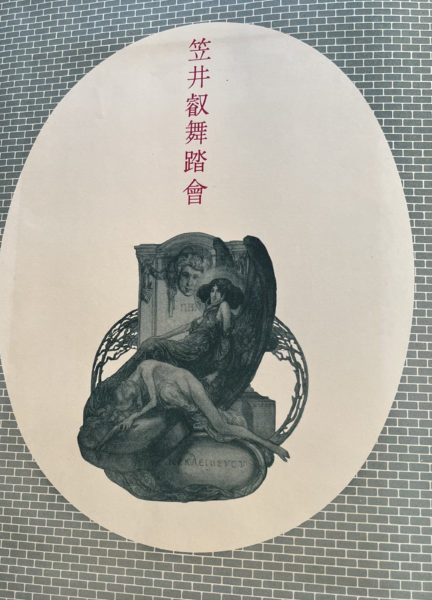
In January 1979, I performed “A Tale of Misery” by Marquis de Sade in Butoh Work Collection I, and “One Hundred and Twenty Days in Sodom” by Marquis de Sade in Butoh Work Collection II in March.
In my mind, there was an idea that I make it that year's theme that “I would connect dance with literary subjects.”
Generally speaking, people do not think of dance in terms of crime. Mr. Kazuo Ohno, however, was clearly aware that as long as he was dancing, he was a criminal, and that he was a criminal himself. Mr. Hijikata called his dance “dark butoh,” but dark means violence, and there is an arbitrary aspect toward crime. Butoh could not have come into being without the criminal aspect and its connection to the body.
I still think that Mr. Ohno and Mr. Hijikata's connection of dance with crime and the dark side of humanity was an amazing event in the history of dance in Japan. Perhaps it was because I met both of them when I was young that I came to think of the connection between human violence and darkness and dance as a natural act.
For example, when a lover says, “I want you to tell me in words how you feel about me,” if you dance, it will be a kind of violence for the other person. A dancer who allows himself to do so is, in a sense, a criminal, and he needs to be aware of this. If you are not aware of this, you are never a butoh dancer.
The works “The Tale of Misery” and “One Hundred and Twenty Days of Sodom,” both based on Marquis de Sade, were created from the aspect of Sade's criminality, and were works that tackled the anarchism of the body. I danced a solo in “The Tale of Misery”. The subtitle of “The Tale of Misery” is “The Story of Juliet and Justine,” which is the original work of the Sade Trial in Japan.
For “One Hundred and Twenty Days of Sodom,” I performed with five men from Tenshikan. All the dancers danced improvisationally. There is one microphone on the stage, and when one person speaks, the microphone is passed to the next person, who receives it and speaks. I explained the concept to the dancers, but there was no agreement as to who would speak and what they would say. The stage was such that anything could be done, and in fact, everyone did whatever they wanted.
Looking back on it now, I honestly don't know if it was a good idea for me to perform these two pieces. Thinking about it again, it could be said that we were just dancing on the theme of Sade. Just because I danced on stage on the theme of two crime literatures, I am not sure if I was really confronting the violence of the body. Is it really possible to make a theme and to dance about it at the same time?

Continue to Akira Kasai Begins Butoh <16>.
Profile
 Akira Kasai
Butoh dancer and choreographer, who became friends with Tatsumi Hijikata and Kazuo Ohno at a young age in the 1960s, and gave numerous solo butoh performances mainly in Tokyo and elsewhere. In the 1970's, operated Tenshikan Butoh dance school where he trained numerous butoh dansers. From 1979 to 1985, studied abroad to study in Germany.Studied Rudolf Steiner's anthroposophy and eurythmy. After returning to Japan, he did not perform on stage and was away from the dance world for 15 years, but returned to the stage with "Seraphita". Since then, he has given numerous performances in Japan and abroad, and has been praised as "the Nijinsky of Butoh". His masterpiece "Pollen Revolution" was performed in various cities around the world. He has created works in Berlin, Rome, New York, Angers, the Centre National de Danse Contemporaine de France, and elsewhere. https://akirakasai.com