笠井叡 舞踏をはじめて <14>
Akira Kasai Begins Butoh <14>
Akira Kasai studied under Kazuo Ohno, interacted with Tatsumi Hijikata, and gave birth to the word "butoh". He will talk about his life and his own butoh.
In March 1976, I performed “Tristan und Isolde” at Kudan Kaikan.
Following “Tannhäuser” in 1969, I also danced Wagner in “Tristan und Isolde”. These were special works for me.
“Tristan und Isolde” has two women in the cast. Wagner's theme is love between a man and a woman, and this is most clearly expressed in “Tannhäuser” and “Tristan und Isolde”. The combination of music and emotional power is a characteristic of Wagner's work, and the combination of death and life takes emotions to unknown places. I think Wagner was a man who created music immersed in a tremendously vast world of emotions that man had not yet discovered. I use Wagner's music because it conveys through music the emotions that Wagner discovered and that I do not know. That is extremely attractive to me. But I don't think I have done enough with Wagner.
The basis for me to dance during this period was to “extract unknown emotions”. I cannot create a dance based on a concept alone, and I cannot find meaning in it. My dance cannot be created based on such a concept. When I have a concept, if there is no emotion to support it, I cannot move at all. It is not about good or bad feelings, but whether or not I can give birth to an emotional power within that concept that I have never encountered before.
There are still so many areas of emotion that we don't know about. The emotions we know are so few and far between that it doesn't matter if we dance with the concept or not. Through music, we can learn about emotions that we do not know. To do this, we need to dance, not just listen. When you dance, the emotions in the music and your body become completely one. Unknown emotions in your body come to the surface. Not only the music of great musicians, but also children's songs or enka, there is such an element in music. To bring out emotions that I do not know, that is something I have not yet perfected, and in that sense, I cannot quit dancing. There will be no reason to quit.

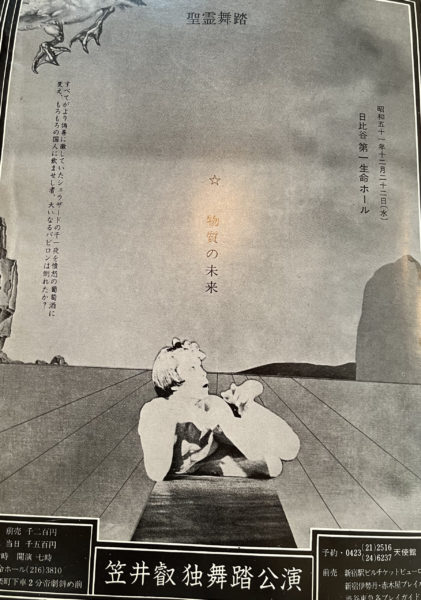
In December 1976, I gave a solo recital “The Future of Matter” at Hibiya Dai-ichi Seimei Hall. Danced Beethoven's “Ninth Symphony” in its entirety for the first time.
At the end of the year 1976, I suddenly decided to dance the “Ninth”. I decided to dance the entire piece solo, improvising everything. The title “The Future of Matter” means that matter will not be matter forever, and that matter itself will gradually change in the future. It was intended to express the idea that matter is the root that creates the human body, and that there is one new future in it.
Why does Beethoven's music have so much energy for dance? Beethoven's music is exceptional in terms of its connection to dance. No matter how great a musician's music may be, it still does not have the energy that comes from Beethoven's music. Beethoven is special to me, and that is a bit of an enigma.
In the past, European composers were limited in their activities: one was church music, and the other was the creation of dance music. Music and dance are like brothers, and for a long time dance and music have developed together in Europe.
For example, Tchaikovsky created “Swan Lake,” but that piece would not have been created without ballet. Beethoven, on the other hand, pursued neither church music nor dance music, but music alone in its purest form. When Beethoven created music composed in the form of pure music, the music became independent and no one wanted to dance to it. Music and dance were separated.
Beethoven composed from within himself with a clear will. That is the greatness of Beethoven as a musician. He created sounds from within his own body and composed music with a steel will to compose. It is wrong to think that it is natural for a composer to compose. At that time, the work of composing was the event of great importance.
In the case of Bach, for example, I think he was more conscious of the fact that he was given sounds by God in his own church life. He must have had little awareness of composing music on his own. Even the musical scale “Do Re Mi” was not created by the composer, but was given to him as a gift. It was Bach's music that borrowed the musical scale created by God and expressed it.
In the period before Bach, there was Baroque music, and further back, there was church music, and at that time, all you needed was a dolemifa solasid to make music. Music was made when humans had the musical scale, the dolemifa solasid. It was Pythagoras who said, “The universe is always playing music,” and I agree with him. Music is not something created by human beings, but something the universe is playing, and human beings are only a mere listener to it. The musical scale had existed before humans created it.
It was Bach who heard the music sung to him by the gods and composed it. It was much later that Bach himself developed a sense of composition, and until then, I think he was aware that he was not creating music, but rather receiving the music that was given to him. Beethoven, however, clearly had the awareness that he was creating music, not receiving it as a gift from God.
What Beethoven had inside him was closer to that of a dancer than to that of a musician. Only Beethoven had that. Bach and Mozart both have many dance elements, but I don't feel that the composer himself was a dancer, as Beethoven was. Beethoven was a very intense person, and he was radical in his words and actions, criticizing aristocratic society. His influence was great, and although he was a musician, he exerted more power over the world than his music. I feel that such Beethoven's existence itself is dancer-like and overlaps with dance-like energy.
The first movement of “The Ninth” begins with an image of gods descending to the earth like a lightning strike, and ends with a sudden change in the middle of the movement as they descend to the human world. In the second movement, when the famous tintin-tintin rhythm is played, the gods disappear from sight and a history of mankind begins. In the third movement, there is a kind of peace in which the gods and humans coexist with each other, and in the fourth movement, the music of joy begins. The music of joy refers to the future that has not yet been realized on earth, and it is the future that emerges from the metamorphosis of the violence that every human being possesses into joy, which is entrusted to the song of joy. This is the point where the future of this kind is most in harmony with dance.
Dance is violence. It is not destructive violence, but the energy itself can only be described as violence. Dance without violence is not very interesting. To dance “The Ninth” is to transform the violence in human beings into love too. In that sense, “The Ninth” is a very attractive piece of music.
With “The Future of Matter,” I was able to dance Beethoven's “The Ninth” in its entirety for the first time. It was one of the reasons for me to become more conscious of deepening my connection with music.
Continue to Akira Kasai Begins Butoh <15>.
Profile
 Akira Kasai
Butoh dancer and choreographer, who became friends with Tatsumi Hijikata and Kazuo Ohno at a young age in the 1960s, and gave numerous solo butoh performances mainly in Tokyo and elsewhere. In the 1970's, operated Tenshikan Butoh dance school where he trained numerous butoh dansers. From 1979 to 1985, studied abroad to study in Germany.Studied Rudolf Steiner's anthroposophy and eurythmy. After returning to Japan, he did not perform on stage and was away from the dance world for 15 years, but returned to the stage with "Seraphita". Since then, he has given numerous performances in Japan and abroad, and has been praised as "the Nijinsky of Butoh". His masterpiece "Pollen Revolution" was performed in various cities around the world. He has created works in Berlin, Rome, New York, Angers, the Centre National de Danse Contemporaine de France, and elsewhere. https://akirakasai.com