笠井叡 舞踏をはじめて <16>
Akira Kasai Begins Butoh <16>
Akira Kasai studied under Kazuo Ohno, interacted with Tatsumi Hijikata, and gave birth to the word "butoh". He will talk about his life and his own butoh.
In May 1979, I performed "Dead Beauty" (Schubert), a collection of Butoh works III based on Edgar Allan Poe, at Hibiya Dai-ichi Seimei Hall. It was my last performance before going to Europe.
The basis for "Dead Beauty" was the work of American writer Edgar Allan Poe. I have heard that when Yukio Mishima wrote his novels, he first decided on the ending and structured the story to get there, and the same is true of Poe. For example, Poe's representative poem, "The Great Raven," was written by calculating the psychology of each word, saying, "If I give this word, the reader will feel this way." It is a work of literature, but it is not a work of naturalistic splendor, but a work of technically calculated splendor.
Dance improvising Poe. What I was trying to do there is to accumulate the fruit that does not exist in the world by piling up the words of falsehood. It was not about dancing an artificially created elaborate work, but about assimilating with the spirituality of the piece.
The five women of Tenshikan appear in "Dead Beauty". It was all improvisation, not choreography, and I told everyone to do whatever they wanted to do.
Choreography is similar to magic tricks. There are two cases. One is that a choreographer exposes the secret to dancers and the other is that a choreographer does not do it. Namely, some choreographers may just say "Do it this way," and other ones may say "Do it this way, because the things will head to this direction." I prefer the former. Although it is unkind, I don't reveal the secret until the very end. It is much more interesting to dance without knowing the story.
If the dancers themselves know their intentions clearly and say, "This is how I want to dance, please watch," the audience will not pay much attention to the dance. In order to impress the audience, it is necessary to create something that even the dancers are not aware of. For this reason, it is better to have the dancers go on stage without revealing the story. Sometimes my aim does not come out on stage. That is fine, as long as I make adjustments while dancing on stage myself. Even when I was working on "Dead Beauty," I avoided explaining in direct words, hoping that everyone would gradually get a sense of it during the rehearsal process.
Another theme of "Dead Beauty" was my desire to confront directly with Schubert, the musician. I used "Unfinished" and "Death and the Maiden" in the work. In my mind, no piece by Schubert surpasses "Unfinished". Schubert, the musician, exerts a great inspiration for dance. There is a sense that the physicality, qualities, and inner life of Schubert, who creates the music, gives me great strength in dancing. Schubert was a very shy and small-minded musician, but he had the strength to protect the world of music no matter what happened to him. In Schubert's music, there is the power of music created with a strong will, and when that power is directed toward dance, it becomes great energy. The two works that bring this together the most are "Unfinished" and "Death and the Maiden."
The music of Schubert, Bach, and Beethoven are all different when captured by the body. The difference in their music is not a difference in musicality, but rather, to put it in an exaggerated way, what God has given to each of us is different. It makes me wonder why each human being has such different energy and a different body. I wanted to connect Schubert's own unique energy that flows in Schubert with dance in my own mind. It was with this idea in mind that I worked on the piece "Dead Beauty".
After a lapse of time, at the end of 2019, I danced "Unfinished" for the first time in 40 years. I have never danced it anytime else. I don't really like re-enactments, and I feel that I have danced it once, that's all I need to do. "Pollen Revolution" and "Dancing the Constitution of Japan" are exceptional in my opinion, and the reason I have been able to perform them again and again is because the people around me set them up. The set for "The Voyage of the Prince of Takaoka" is so large that it would be impossible to perform it again, even from an economic standpoint. Once the performance is over, the set is burned.

In July 1979, I moves to Europe. Leaving Tenshikan behind, I began a new life in Germany.
I was 35 years old when I went to Germany. It was two months after "Dead Beauty" and I went there with very little preparation. It was quite sudden, but once I decided to go, I didn't pay much attention to what people said around me. I left the Tenshikan as it was. It was a kind of rental practice space that everyone was free to use.
However, when I suddenly left Japan, everyone became angry, saying that I had created the Tenshikan but left without any notice and that I was irresponsible. However, in the first place, Tenshikan was not a company at all, but simply a group of people who wanted to work together on the dances I was doing at the time. Even while I was gone, reportedly there were still people who came to Tenshikan, like Ms. Setsuko Yamada and Mr. Kota Yamazaki.
I first lived in a place called Freiburg in southern Germany. I chose Freiburg by chance, but I had to learn German anyway, so I went to a language school, the Goethe Institute, for three months. The Goethe Institute was supposed to be a language school, but for some reason it was full of young Germans. When I wondered why, I was told that the school's teacher was teaching aikido and they had come to learn it.
I actually have a dan in aikido and can teach people a little. When I saw that the students were into it, I said, "If you are so interested in aikido, I will teach it to you," and a lot of people came. I still feel bad about it, but after I started teaching, people stopped going to the language teacher. Because of this, I also made a lot of German friends. As I went to the movies and plays with them, I found myself completely integrated into the German community.
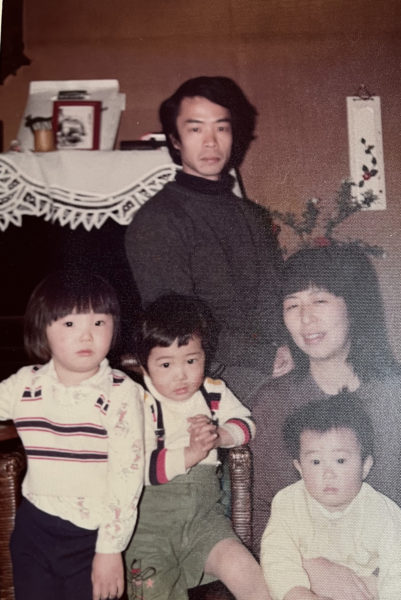
I did not invite my family to Germany until more than six months later. It took a lot of time to complete the procedures. At the time, my eldest son Chikashi was 10 years old, my second son Reiji was 7, and my youngest son Mitsutake was only 5. We had to go through the school procedures and prepare a house to live in. My mother wanted to go to Germany with me, but I convinced her that it was not possible, so she is staying in Kokubunji.
We all started living in Germany without having studied German. But children are language geniuses, and after one year, they could speak German completely. Unlike the children, I had a very hard time with German.
Continue to Akira Kasai Begins Butoh <17>.
Profile
 Akira Kasai
Butoh dancer and choreographer, who became friends with Tatsumi Hijikata and Kazuo Ohno at a young age in the 1960s, and gave numerous solo butoh performances mainly in Tokyo and elsewhere. In the 1970's, operated Tenshikan Butoh dance school where he trained numerous butoh dansers. From 1979 to 1985, studied abroad to study in Germany.Studied Rudolf Steiner's anthroposophy and eurythmy. After returning to Japan, he did not perform on stage and was away from the dance world for 15 years, but returned to the stage with "Seraphita". Since then, he has given numerous performances in Japan and abroad, and has been praised as "the Nijinsky of Butoh". His masterpiece "Pollen Revolution" was performed in various cities around the world. He has created works in Berlin, Rome, New York, Angers, the Centre National de Danse Contemporaine de France, and elsewhere. https://akirakasai.com