笠井叡 舞踏をはじめて <5>
Akira Kasai Begins Butoh <4>
Akira Kasai studied under Kazuo Ohno, interacted with Tatsumi Hijikata, and gave birth to the word "butoh". He will talk about his life and his own butoh.
Mr. Hijikata I saw in "Anma: The Story of the Theater That Supports Lust" was intense. With that excitement still fresh in Kasai's mind, he met Mr. Hijikata in December of the same year.
It was two months after "Sacrifice. When I was at Mr. Ohno's house, a man with a very bad look in his eyes came from across the hall. I thought it was a yakuza, but Mr. Ohno introduced him to me and said, "This is Mr. Hijikata". That was my first encounter with Mr. Hijikata. Mr. Hijikata had heard rumors about "Sacrifice" from others. When I met him for the first time, he said, "I heard you killed 3,000 chicks?" I was told.
The spring after I met Mr. Hijikata, I entered Meiji Gakuin University after a two-year ronin (without job or educasion) period. The campus is located in Shirokane, which was one of the factors that led me to become deeply involved with Mr. Hijikata. From Meguro Station, going left, there is a bus heading to the university, and going right, there is a bus heading to Mr. Hijikata's studio, Asbestokan. Getting off at Meguro Station, I pondered which way to go. Of course, I should probably go to the university, but I end up going to the asbestokan. In those days, we were not in the habit of making appointments, so we would go there on a whim and return if Mr. Hijikata was not there, and if he was there, we would have a drink together, talk, and sometimes spend the night together as it were.
Mr. Hijikata usually created his works at night. During the day, he taught ballet to children at Asbestos Hall, and after 10:00 p.m., young people would gather and practice until morning. I also performed in Mr. Hijikata's works, "Rose Color Dance-A LA MAISON DE M.CIVECAWA (Toward Mr. Shibusawa's House)" and "Sexual Love Onchogaku Shinan, Tomato", and I also participated in several smaller works.
Mr. Hijikata was 15 years older than me. Although we were from different generations, I said what I wanted to say without worrying about my age, and I may have been rude to him. However, there was definitely an educational aspect to Mr. Hijikata, and he was trying to nurture me.

『犠儀』(左)
Mr. Kazuo Ohno and Mr. Tatsumi Hijikata, two powerful beings who changed the history of Japanese dance, I met them, spent time with them, and was greatly influenced by them.
Mr. Hijikata's story begins with a riddle. Mr. Hijikata points to an electric stove and asks, "Mr. Kasai, what is this?" I ask, "It is an electric stove isn't it?". But Mr. Hijikata says, "This is not a stove, but a thing desperately trying to imitate the sun". Another time, he said, "There is a person walking toward me. When I look at it from the back, his back is scorched black". I did not understand what Mr. Hijikata was trying to say. I could not say, "I see," and replied, "Oh, I see". It is not a ping-pong-ball exchange, but a one-sided, kind of Zen-like conversation.
Mr. Hijikata's way of handling things is unique, and consists of stripping away one by one the things that make sense on a daily basis. That is why even a single stove can evoke an infinite number of images, and depending on how you look at it, it can even become a sun.
Mr. Hijikata said, "Stand up a single stick and drop it with a snap, and in those few seconds I can evoke an infinite number of images". Throughout his life, Mr. Hijikata kept saying how poor the human view of things is. He taught me one way of looking at things, saying that only by making various hypotheses would I be able to see something there. He was a person who repeatedly kept saying that it was a new way of perceiving things.
Mr. Hijikata called the "crime dance" a kind of shocking dance that is unbearable to watch, and he put a lot of effort into it. I was attracted to Mr. Hijikata in my own way, and I could sympathize with him. If there is an expressed crime and the crime itself, the expressed crime was the part that I felt was very important to me. I had a big question about what it means to tell a lie with the body, although telling a lie is in the realm of words. It is natural to do the truth with the body, but to be able to do the untruth with the body is, I thought, an amazing thing. Perhaps that was similar to Mr. Hijikata's concept of crime dance.
Isadora Duncan freed her body from the stylized movements of classical ballet and expressed nature such as wind and water with free movement. I was not interested in any of that. If natural movement is movement without lies, then I was interested in the most anti-natural things in the body. When you express something false with your body to the point of betraying nature, the dance goes to the realm of crime. As I attended Mr. Ohno's training, these thoughts gradually became clear to me, and I think that is why I felt something in common with Mr. Hijikata when we met. In the sense of having an aesthetic sense, I felt that Mr. Hijikata was a kind of senior to me. However, there was no moral element at all, and that may be the decisive difference between Mr. Ohno and Mr. Hijikata.
Mr. Ohno was an ardent Christian and a teacher at a girl's school, so he was a person with a strong sense of morality. At the same time, he had a side of cruelty and a willingness to go where ordinary people would not go. I think he was able to strike a good balance between the two. Mr. Ohno was a man who was interested in things that ordinary people would never be interested in and who developed his own imagination to any extent, and this in itself was a part of who Mr. Kazuo Ohno was. For me, there were aspects of Mr. Ohno that were difficult to understand, and so even though I felt sympathy for Mr. Hijikata, there were many aspects of Mr. Ohno's way of creating dance that I did not fully understand.
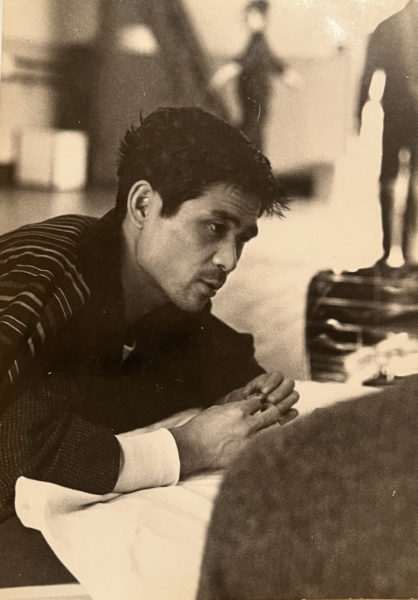
土方巽
In 1965, I appeared in a Hijikata work for the first time in "Rose Color Dance - A LA MAISON DE M.CIVECAWA (Toward Mr. Shibusawa's House)". The venue was the Sennichiya Hall in Shinanomachi, and in addition to Hijikata, the cast included Kazuo Ohno, Mitsutaka Ishii, and Koichi Tamano, with art by Natsuyuki Nakanishi, Mitsuo Kano, and Genpei Akasegawa, and music by Takehisa Kosugi and Yasunao Tone.
At the beginning of the work, ten men in white garments stand backward on a set that has two upper and lower levels. The men appeared to be standing and urinating against a wall, and that alone had quite an impact.
Men in a rickshaw appeared on the stage, a man with a rising sun flag wrapped around his body was on the side of the stage, and a barber was clipping their heads with hair clippers. The men's faces and bodies were painted green to show how their bodies were changing, fish scales were taken and carried to the stage, a mole was drawn on a large illustration of a face, and Mr. Hijikata danced while sticking a fencing sword there. ...... There were a lot of really interesting things that happened. One of the most unforgettable moments for me was the duet between Mr. Ohno and Mr. Hijikata. It was the first duet by two dancers wearing simple pure white dresses, and it left a very strong impression on me.
Also, although it did not come to fruition, Mr. Hijikata initially suggested that we have Bin Akao, a former member of the House of Representatives and a right-wing activist, make a speech at the beginning of the performance and start the show from there. Mr. Hijikata also said that he wanted to create a giant earpick several meters long and have the audience scratch each other's ears here and there. Just imagining this scene makes me squirm a little.
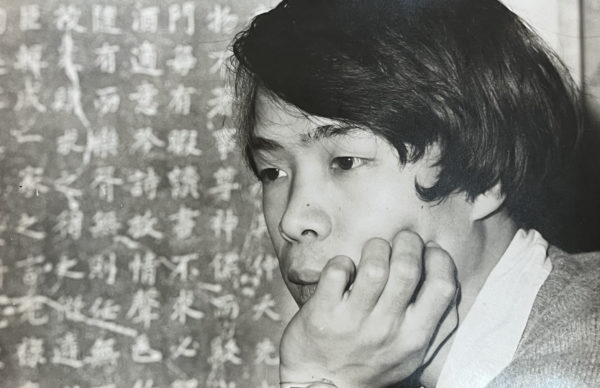
20歳の頃
Continue to Akira Kasai FBegins Butoh <6>.
Profile
 Akira Kasai
Butoh dancer and choreographer, who became friends with Tatsumi Hijikata and Kazuo Ohno at a young age in the 1960s, and gave numerous solo butoh performances mainly in Tokyo and elsewhere. In the 1970's, operated Tenshikan Butoh dance school where he trained numerous butoh dansers. From 1979 to 1985, studied abroad to study in Germany.Studied Rudolf Steiner's anthroposophy and eurythmy. After returning to Japan, he did not perform on stage and was away from the dance world for 15 years, but returned to the stage with "Seraphita". Since then, he has given numerous performances in Japan and abroad, and has been praised as "the Nijinsky of Butoh". His masterpiece "Pollen Revolution" was performed in various cities around the world. He has created works in Berlin, Rome, New York, Angers, the Centre National de Danse Contemporaine de France, and elsewhere. https://akirakasai.com