笠井叡 舞踏をはじめて <10>
Akira Kasai Begins Butoh <10>
Akira Kasai studied under Kazuo Ohno, interacted with Tatsumi Hijikata, and gave birth to the word "butoh". He will talk about his life and his own butoh.
When I was a senior in college, I gave a solo recital, "Chigo no Soshi (Storybook of infant)." The student movement was intensifying.
The so-called Todai Conflict, in which students barricaded themselves in the Yasuda Auditorium of the University of Tokyo and occupied the school, was taking place, and the school struggle was becoming more and more intense. Demonstrations were taking place all over the place, and students were wielding sticks against the police.
I was also a university student, but I had no interest in the school struggles. I was sober, or I thought there was nothing I could do about it. When a group is formed, you have to move with the others. If you leave the group, you are said to be betraying your friends, and eventually you will be purged. I am sure that those who were involved in the school struggle knew this.
To begin with, I do not believe in the power of a group. The reason why I do dance is not about the power of a group of people, but about what it means to be an individual body. I was not interested in political movements, including such things, and I ended up doing nothing but dancing. From That time, the place like school became unattractive to me. But I didn't want to stop what I had started, so I decided to do something about it once I was in, and I continued to attend until graduation.
I never made fun of those who were involved in the student movement, but I had no intention of doing the same thing myself. However, I think that the energy that flows through dance and theater, if taken in the wrong direction, can go into political movements. This tendency is stronger in the theater, and in fact, a number of propaganda groups with a revolutionary communist orientation were born at that time.
It was not possible for me to belong to any political party as a way of conducting myself. If the body itself is an idea, then I had no choice but to adopt a form of expression such as dance or butoh. There was a clear line of demarcation between me and theater people, saying, "I can't be like that". Mr. Hijikata was probably the same way. I feel that he made a distinction' saying "those people are theater people".
During the height of the student movement, Mr. Hijikata was walking with a watermelon through the space between the students and the riot police who were fighting against demonstrators. His physical appearance at that time was not that of the riot police, nor that of the students. He is not saying that both of them are bad, but he is suggesting that there is some other way to be a human being. Thus he tries to show a dancer ouiented perspective.
The venue for "Storybook of infant" was the small hall of the Shinjuku Kosei-Nenkin Kaikan. Just before the curtain went up, Ms. Michiyo Yamamoto, a bookbinder, came running into the hall and asked me, saying, "I'm being followed by the police. Please tell me where to go to deceive them". Ms. Yamamoto's husband was Yoshitaka Yamamoto, the chairman of the All-campus joint struggle committee for the University of Tokyo, who had occupied the Yasuda Auditorium, and was continuing his underground activities after being chased by the police. It seems that the police were following Ms. Michiyo in order to find out where Mr. Yoshitaka was hiding. Ms. Michiyo usually came to see my performances often, and since we were friends, it was perfectly acceptable for me to hide her. I told her, "Please come in," and she was able to escape the police's scrutiny. It was a time when many things happened that would be unthinkable today.
I shaved all of my hair for the first time in "Storybook of infant". There is an emotional aspect to hair, and perhaps by shaving it, I wanted to transcend the materialistic aspect.
I drew a large tiger on the stage and broke it into four pieces and shook it. The tiger is an animal with an Asian flavor, and it is swinging in the darkness. The child is a boy who is like a god, and he is dressed in a gorgeous kimono. My mother, a pipe organist, played the reed organ on stage, and I danced on the organ. My mother played on stage at that time and also in Mr. Hijikata's "Seiai Onchogaku Shinan Ezu, Tomato".
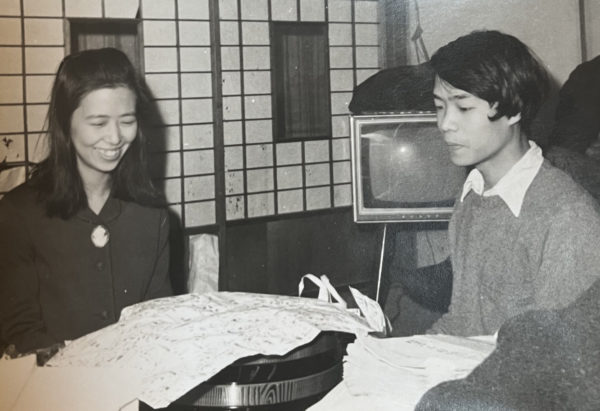
妻・久子と
I graduated from college at the age of 24. I get my first and last job because of marriage.
Even though I was about to graduate from college, there was never any thought in my mind to get a job somewhere and become a worker. However, I did have what looked like a corporate job. My wife's parents told me, "If you don't get a job, we won't let you get married," so I started working with the assumption that I would quit as soon as I got married. But that was only for a short period of time.
I met my wife Hisako when I was a senior in high school and she was a sophomore. I went to junior high and high school at Toho Gakuen boys' school in Kunitachi, and Hisako went to Toho girls' school in Sengawa. One day, at the urging of a junior member of the drama club, we decided to get together with all the girls from the drama club at the girls' school. Hisako was also in the drama club, and that is how I met her. After that, it took about seven years until we got married.
A long-established tempura restaurant called "Funabashiya" in Shinjuku was Hisako's family home. Her father was a man who devoted himself to the reconstruction of Shinjuku after the war, working with the neighborhood association to rebuild the burned-out city. At that time, a large Yakuza organization was active in Shinjuku, and I heard that her father and his family protected the area from becoming a Yakuza town. I guess such a family background must have been a factor. When I told her father, "I am going to marry Miss Hisako," he was very much against it. He told me that I could only have his daughter if I had a proper education and a job," so I went to college. After graduating from college, I got a job at a company. It was an advertising company. I got married at the age of 24 and started living in Kokubunji. However, I was not sure if the company was the right fit for me, and I was in and out of the hospital three times in the first three months of working there. I decided that this was a bad idea, so I left the company as early as three months after I started working there.
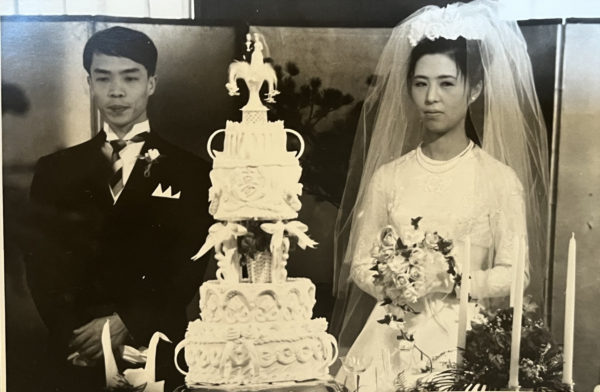
赤坂プリンスホテルで挙式
After quitting the company, I wondered how I would earn an income. Even if I work, an ordinary job is not interesting. So I started doing cabaret shows. However, I had been working part-time in cabarets since college, so it was just a matter of getting back into it.
At that time, cabarets were in their heyday, and there was always a show time at every cabaret house. Mr. Hijikata was also dancing in cabarets all over the place, and I decided to dance in cabarets with him. In addition to the clubs in Yotsuya, I often went with Mr. Hijikata to cabarets in Nippori, Uguisudani, and Ikebukuro. The members changed from time to time, sometimes dancing as solos or duets, and sometimes as many as seven or eight.
Showtime was mostly live music, with a three- or four-piece band in smaller establishments and an orchestra in larger ones. The music was mostly jazz and blues, and we would decide on a title of music, and the rest was mostly improvised. We really did whatever we wanted to do. We danced about 20 days a month, and that covered most of our living expenses. It was an interesting time. I graduated from university at the age of 24, and continued to perform in cabarets until I was around 27 or 28.

大野一雄・チエ夫妻が仲人を務めた
Continue to Akira Kasai Begins Butoh <11>.
Profile
 Akira Kasai
Butoh dancer and choreographer, who became friends with Tatsumi Hijikata and Kazuo Ohno at a young age in the 1960s, and gave numerous solo butoh performances mainly in Tokyo and elsewhere. In the 1970's, operated Tenshikan Butoh dance school where he trained numerous butoh dansers. From 1979 to 1985, studied abroad to study in Germany.Studied Rudolf Steiner's anthroposophy and eurythmy. After returning to Japan, he did not perform on stage and was away from the dance world for 15 years, but returned to the stage with "Seraphita". Since then, he has given numerous performances in Japan and abroad, and has been praised as "the Nijinsky of Butoh". His masterpiece "Pollen Revolution" was performed in various cities around the world. He has created works in Berlin, Rome, New York, Angers, the Centre National de Danse Contemporaine de France, and elsewhere. https://akirakasai.com