笠井叡 舞踏をはじめて <9>
Akira Kasai Begins Butoh <9>
Akira Kasai studied under Kazuo Ohno, interacted with Tatsumi Hijikata, and gave birth to the word "butoh". He will talk about his life and his own butoh.
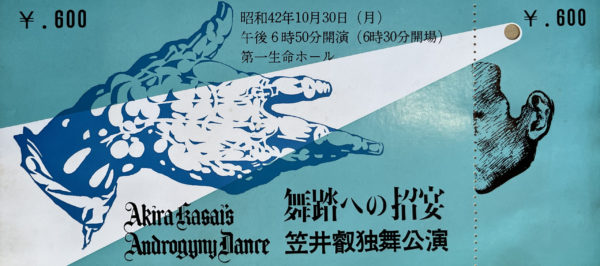
In October 1967, Kasai performed "Invitation to the Butoh". It was his second solo recital after "The Crucifixion Virgin," and he danced it at Dai-ichi Seimei Hall.
I had actually intended to dance a solo in my maiden recital, but it didn't work out that way. So I decided to make this recital a complete solo. The "Invitation to the Butoh" is a collection of small pieces, and I danced "The Crucifixion Virgin," that Mr. Ohno choreographed for me at my virgin recital, "Story dance to Miss O," "The Spirit of the Rose," "Prelude to the Afternoon of God of Shepherds," "Henkyusho (musical scale exerption" and "The Martyrdom of St. Sebastian in Rape Flower Male Costume" In a very real sense, this was my first performance in solo form.
This was the first time Mr. Yukio Mishima came to see my performance. I seem to remember that I extended the invitation. I danced "The Martyrdom of St. Sebastian," which may have been one of the reasons why I attracted his interest. Mr. Mishima passed away three years after this recital.
However, I was not able to meet Mr. Mishima at that time, and I heard that he left after talking with Mr. Shibusawa at the venue. He told him that he had been to India for a research for his novel, and with a tanned face, he said, "The Ganges River is very dirty, but Hindu people are soaking in it and praying. The sight of the morning sun shining on the river was impressive".
I first met Mr. Mishima at Mr. Hijikata's rehearsal hall. One day, Mr. Hijikata said he was going to build a members-only bar in the Asbestos Kan. I thought, "Why a bar in a dance rehearsal hall? Mr. Hijikata told me that the bar was named "Gibbon," after a man who wrote an ancient history of Rome called "The History of the Decline and Fall of the Roman Empire". Mr. Hijikata held a celebration for the opening of "Gibbon" and Mr. Mishima rushed there. Mr. Mishima was extremely crisp. But I was a college student chick at the time, so I never got to talk to him personally.
Mr. Mishima speaks in a bit shrill voice. When I saw him in "Gibbon," he laughed a lot. When he was at my stage, he was also laughing like a kakkakkakkakka. According to Mr. Shibusawa, usually in "The Afternoon of the God of the Shepherd", people dance standing up, but it was funny that Kasai was dancing on all fours and dressed as an animal. That dancing style seemed to have made Mr. Mishima laugh.
Many poets, including Mr. Shuzo Takiguchi, came to see "Invitation to Butoh". Although I did not personally interact with poets, they came to my maiden recital the previous year because of Mr. Hijikata, and since then various people have been sending me books. Mr. Hijikata's friendship was wide, especially close with Mr. Shibusawa and Mr. Mishima.
When the dance was over, Mr. Hijikata and Mr. Ohno brought a large bouquet of roses to the stage; there were about 100 roses, and I knocked them to the floor and shattered them. I sowed the petals to the heavens, and in the falling petals, I ate the petals and did an encore. It was a rose I had been given, but I broke it all apart.

After three years of practice, Kasai became independent from his teacher, Mr. Kazuo Ohno.
I was able to take one-on-one lessons with Mr. Ohno for three years. It was truly a precious time.
One of the many things that Mr. Ohno did in his practice was to look at paintings by European artists and improvise movements based on the images that came from the paintings. However, Mr. Ohno's way of creating images is not to directly transform what he sees in a painting into movement, but to digest what he receives in his mind and transform it into an image. In other words, Mr. Ohno's way of creating movement is two-fold, which is also his characteristic.
One day, Mr. Ohno said to me, "Mr. Kasai, yesterday when I was cleaning the boiler at school, a cricket came and I brought it home. The reason why is because when I looked closely at the cricket, it was my mother," he once said. Of course, that is just an image, but instead of seeing one thing and imagining something as it is, he turns it into another image in his mind. It is an image that is almost like a fantasy, which is bullshit and wonderful if viewed from another angle.
I have met many unique people, but Mr. Ohno was one of a kind, someone I experienced for the first time. My first and storong impression of Mr. Ohno was, "There is such a person in the world." Mr. Ohno's way of looking at things was completely different from the norm. When he looked at or thought about something, he did not look at it from the front in all honesty. When one thing is there, he does not just see it as itself, but is interested in aspects of things that can not be normally seen. A person who thinks of things from multiple angles and becomes confused and drowns in the confusion, saying, "This is like this when I look at it from this side, but this is like this when I look at it from that side. ...... "It might have been difficult to understand him under normal circumstances.
Mr. Ohno has his own world. But when I was asked, "What kind of image do you have?" I thought, "I want an objective image". The image I had in mind was not a delusion, but an objective image. There is nothing wrong with starting from a delusion, but I wanted to know about another objective image session. Mr. Ohno's image was too personal, and although it was his path, it did not seem to be my path. Around that point, my time with Mr. Ohno dropped out of my mind.
In 1968, Mr. Tatsumi Hijikata held a butoh performance "Tatsumi Hijikata and the Japanese - Rebellion of the Body". It was Mr. Hijikata's first and last solo performance.
1968 was an important year in many ways. In that year, Mr. Hijikata presented "Rebellion of the Body" and I presented "Chigo no Soshi (Storybook of infant)".
One day, Mr. Hijikata said, "Mr. Kasai, I'm going to do it next time". Mr. Hijikata had not given a solo performance for a long time, and this was his first time. It was "Rebellion of the Body," which was performed at the Nippon Seinenkan. However, "Rebellion of the Body" was not the original title of the show, but rather the title that became popular when Mr. Suehiro Tanemura wrote a text titled "Rebellion of the Body" on a photo of Mr. Hijikata taken by Mr. Eikoh Hosoe. What was written on flyers and posters at the time was "Tatsumi Hijikata and the Japanese". I don't know if I can call this a title, but I think that is probably what Mr. Hijikata wanted to say.
It was a truly wonderful performance. However, I had a feeling in my mind that "this is not what solo dance is about," and I wrote about my impression of it in "Gendai shi techo" ("Contemporary Poetry Handbook"). That was negatively received. It was said, "Kasai gave a scathing review of Tatsumi Hijikata's stage," and it remained with me until later.
I never meant to be harsh. What I wanted to say then was that Mr. Hijikata did not show a dance, but only an encounter between objects and bodies. He put a pig on the stage and he sat next to it and stayed still for a while, he moved a huge phallic object on the stage, he made a very large aluminum plate ring on the stage, he tied his hands and feet together and hung him in the air while strapped to a crucifix. ...... Those things that Mr. Hijikata did were not solo dances for me. If you set up a body and an object, the meaning of being alone does not appear at all. The meaning of being solo would disappear. So I wrote, “How about this as a way of solo dance?" Then I was criticized for "criticizing Tatsumi Hijikata".
My idea of solo dance is to what extent it is possible to create a space with only one's body without relying on objects. Mr. Hijikata's solo was a solo that relied on objects. That is not my idea of a solo. But if that is good for Mr. Hijikata it is not for me to say anything about it.
Continue to Akira Kasai Begins Butoh <10>.
Profile
 Akira Kasai
Butoh dancer and choreographer, who became friends with Tatsumi Hijikata and Kazuo Ohno at a young age in the 1960s, and gave numerous solo butoh performances mainly in Tokyo and elsewhere. In the 1970's, operated Tenshikan Butoh dance school where he trained numerous butoh dansers. From 1979 to 1985, studied abroad to study in Germany.Studied Rudolf Steiner's anthroposophy and eurythmy. After returning to Japan, he did not perform on stage and was away from the dance world for 15 years, but returned to the stage with "Seraphita". Since then, he has given numerous performances in Japan and abroad, and has been praised as "the Nijinsky of Butoh". His masterpiece "Pollen Revolution" was performed in various cities around the world. He has created works in Berlin, Rome, New York, Angers, the Centre National de Danse Contemporaine de France, and elsewhere. https://akirakasai.com